Online Market Research and Surveys: A Comprehensive Guide to Data-Driven Success

Introduction: The Future of Online Surveys and Market Research
It is no longer possible to guess what customers want in the fiercely competitive digital world of today. Assumptions put businesses at risk for unsuccessful product launches, inefficient marketing campaigns, and unsatisfactory customer experiences, all of which can cost millions of dollars and harm their brand. However, it appears that businesses like Apple, Amazon, and Netflix constantly foresee what their customers want before their audiences even realize it. Neither intuition nor luck is their secret. It is the strength of data, gathered and examined via market research and online surveys.

The emergence of digital tools has changed how businesses obtain insights. The days of spending hours on the phone or conducting costly door-to-door interviews are long gone. Instead, real-time feedback collection and analysis are possible for companies of all sizes. Market research and online surveys democratize information by making expert insights available to anyone who knows how to properly create, disseminate, and analyze them.
Knowing the Fundamentals of Market Research and Online Surveys
Online surveys: what are they?
Digital questionnaires called online surveys are used to get data from a specific audience. They can be shared via mobile apps, websites, social media, and email. Online surveys are now the most popular way for businesses to get direct feedback about customer satisfaction, product preferences, and service experiences because they are flexible and affordable.
Market research: What is it?
The methodical process of examining markets, rivals, and consumer behavior is known as market research. It assists companies in spotting opportunities, keeping an eye on market developments, and adjusting to shifting consumer demands. Beyond consumer feedback, market research also includes demographic research, competitor analysis, and trend forecasting.
How They Cooperate
Market research and online surveys work together to create a potent feedback loop. Customers’ unfiltered, first-hand opinions are obtained through surveys, and market research analyzes the answers in light of broader changes in the industry and consumer trends. When combined, they produce a 360-degree perspective that helps businesses make more informed decisions.
The Digital Revolution in Market Research

From Conventional to Digital Approaches
Businesses used focus groups, telephone surveys, and door-to-door interviews for decades. These techniques were slow and costly, despite their effectiveness. Frequently, markets had already changed by the time the results were compiled.
Everything was altered by the internet. Speed, scale, and cost effectiveness were introduced by online surveys and market research. Instead of weeks, a survey can now reach thousands of respondents in a matter of hours. Businesses can take swift action thanks to advanced software that automates data collection and analysis.
Instruments Fueling the Transformation
While artificial intelligence-powered analytics platforms can uncover hidden patterns in massive datasets, platforms like SurveyMonkey, Google Forms, and Typeform have simplified the survey design process. In comparison to traditional methods, online surveys and market research are now not only faster but also far more accurate and predictive thanks to these innovations.
The Significance of Online Surveys and Market Research
Lowering the Risk of Business Choices
There is risk involved in every business decision. A poorly received product or campaign can damage a brand and deplete resources. Businesses can ensure that only data-backed strategies are implemented by using online surveys and market research to validate ideas before they are implemented.
Recognizing Consumer Behavior
The capacity of market research and online surveys to uncover consumer attitudes, behaviors, and thoughts is one of their best features. Businesses can create goods and services that directly meet the needs and expectations of their customers by studying consumer behavior.
Improving Marketing Techniques
Marketing that works requires accuracy. Businesses can test messages, divide audiences, and improve campaigns with the help of online surveys and market research. Marketers can base strategies on real-time data that reflects current customer sentiment rather than making assumptions.
Creating enduring connections with customers
Businesses establish a culture of trust when they regularly use market research and online surveys to gather feedback from their customers. When consumers’ opinions influence goods and services, they feel appreciated, which increases customer loyalty and promotes repeat business.
Important Uses for Market Research and Online Surveys
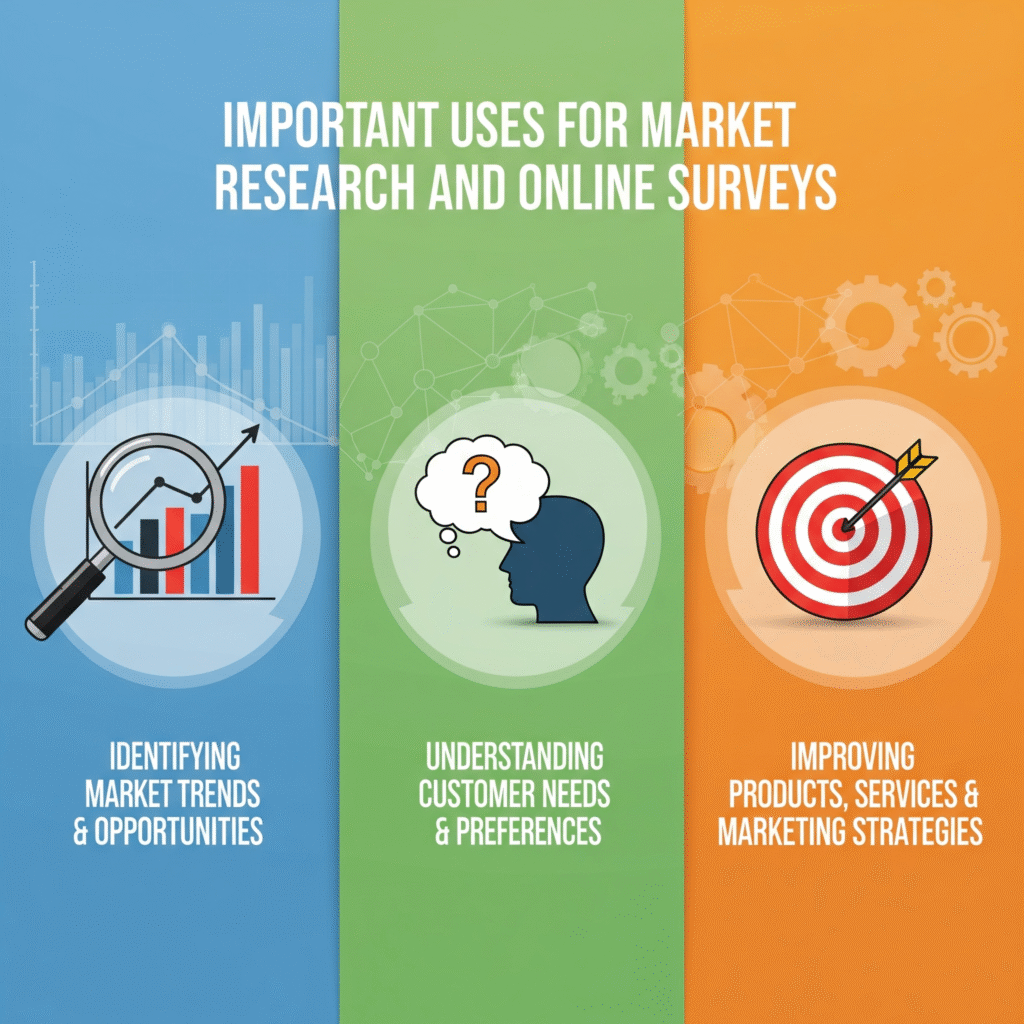
Innovation and Product Development
Businesses can test features, designs, and pricing points of new products using market research and online surveys before launching them. This strategy lowers the chance of failure and guarantees that products meet consumer needs.
Assessing Client Contentment
Surveys are a useful tool for gauging customer satisfaction following a transaction or service encounter. Metrics like Net Promoter Score (NPS) and Customer Satisfaction Score (CSAT) are provided by online surveys and market research and can be monitored over time by businesses.
Analysis of Competition
Businesses can monitor competitors, examine industry trends, and spot market gaps with the aid of market research tools. When paired with surveys, this data enables businesses to take a more calculated stance.
Growth of the Market
Online surveys and market research assist businesses in understanding local competition, purchasing patterns, and cultural preferences when they enter new markets. This facilitates more seamless market entry tactics and lessens the uncertainty associated with global expansion.
Issues with Market Research and Online Surveys
Fatigue from Surveys
Survey fatigue is one of the main issues that companies deal with. Low response rates may result from the deluge of questionnaires sent to customers. To get past this obstacle, surveys must be clear and interesting.
Quality of Data
Results from poorly designed surveys may be deceptive. The data becomes untrustworthy if the questions are too complicated, biased, or ambiguous. Clear goals and meticulous planning are necessary for producing high-quality online surveys and market research.
Trust and Privacy
Businesses must make sure that online surveys and market research adhere to laws like the GDPR in light of the growing concerns about data privacy. Being open and honest about the use of data promotes participation and helps to establish trust.
Best Practices for Successful Online Surveys and Market Research
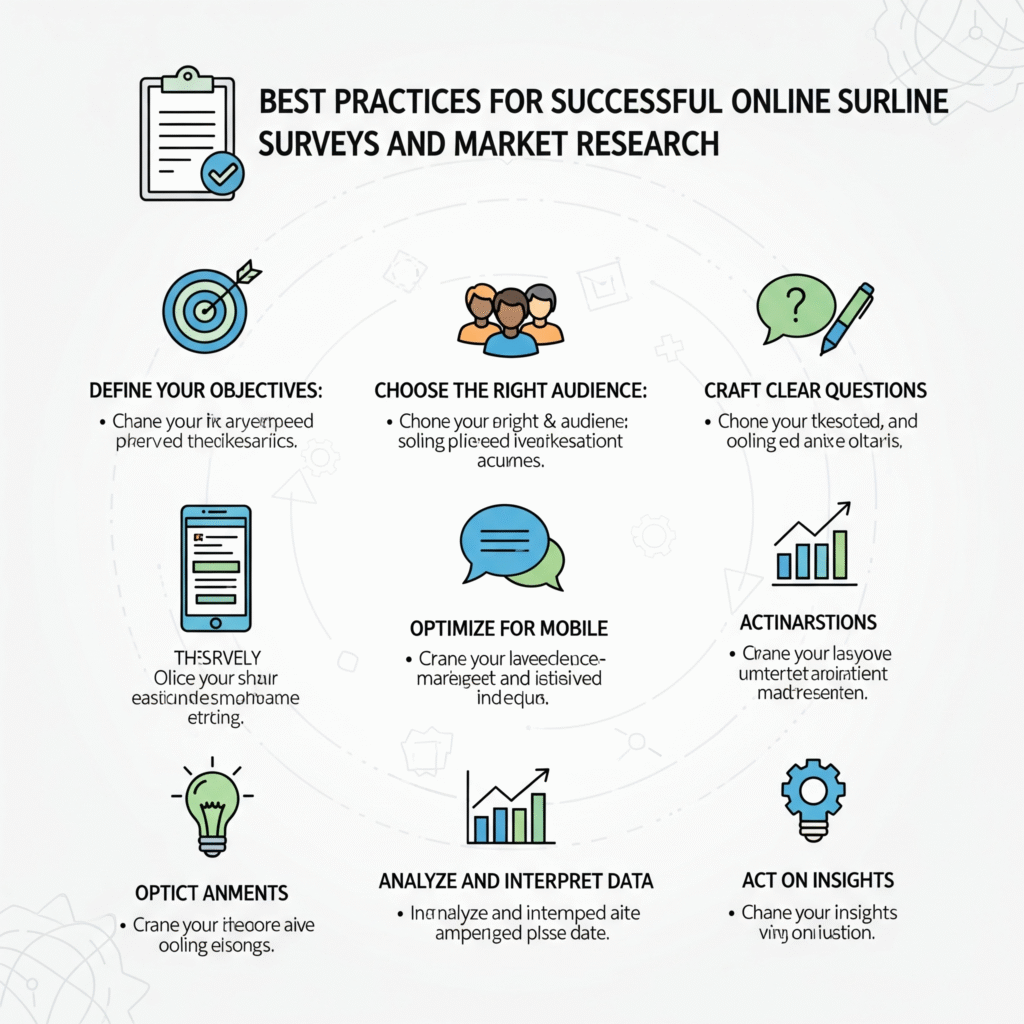
Creating Powerful Surveys
Well-crafted surveys are the cornerstone of sound research. Clear, succinct, and impartial questions are ideal. In order to keep respondents interested through to the end, surveys must also be designed to make sense.
Selecting the Proper Audience
It’s crucial to target the appropriate responders. Meaningful insights will not be obtained from a survey that is targeted at the incorrect demographic. Businesses can reach the right audience by combining survey distribution with demographic research.
Making Use of Advanced Analytics
Modern Online Surveys and Market Research go beyond collecting data. They involve advanced analytics that can identify trends, predict behaviors, and uncover hidden opportunities. These days, analyzing complicated datasets requires the use of AI-driven and machine learning tools.
Constant Improvement
The state of the market is constantly shifting. Companies need to view market research and online surveys as continuous processes rather than one-time events. Insights are kept current and useful through ongoing analysis and frequent surveys.
Online Surveys and Market Research’s Future
More automation and personalization are key components of the future of online surveys and market research. Surveys will dynamically adjust to respondents as artificial intelligence advances, posing more intelligent queries based on prior responses. Research will become even more proactive as a result of predictive analytics, which will assist companies in anticipating client needs before they materialize.
Additionally, blockchain technology might contribute to greater trust and transparency in the gathering of survey data. Blockchain could solve privacy issues and promote broader participation in online surveys and market research by protecting data and granting participants more control.
Conclusion
Relying solely on intuition is no longer sufficient in a world where competition is intense and customer expectations are changing quickly. Online surveys and market research give companies the information they need to manage uncertainty, lower risks, and build deep relationships with clients. Organizations can turn raw data into lucid strategies that spur growth and innovation by investing in high-quality surveys, meticulous analysis, and ongoing improvement.
tap here to get more information about us



Post Comment